Karakha Studio
Swetha Baskaran
Kalamkari Artist · Brooklyn, NY
Karakha, from karakkaya: the myrobalan fruit that is the first mordant in Kalamkari. Plain cotton is soaked in it so the ink and natural dyes can take hold.
Where It Began
A framed Kalamkari painting of the Raas Leela hung in my childhood home, and it was one of the first pieces I recreated. Self-taught at first, I studied historical works and translated their imagery into acrylic. Training in the traditional methods came later: drawing with the kalam (Kalamkari bamboo pen) and working with natural dyes.
Along the Way
Traditional Works
Local deities and temple stories, drawn with the kalam in natural dye on cotton, and one early piece in ink.
The New York Series
My current project is autobiographical, a Kalamkari work about my decade in New York as an immigrant. Living here, I noticed how closely the comics and sketch strips around me resemble the old Kalamkari storytelling cloths. Both move the reader through a story panel by panel, use borders to hold moments in place, and let a recurring figure carry the story from scene to scene. In my cloth panels, a traditionally dressed Kalamkari figure rides the subway to work or browses a Brooklyn thrift store, a newcomer who doesn't quite assimilate and doesn't need to. In New York, there is room to remain visibly, unapologetically yourself.
Every panel starts as a sketch. I began by studying drawings of the city by artists I admired, learning how to capture New York in a few lines. Now I draw scenes from my own life here, the people, the places, small moments from an ordinary week to core memories from the past years. These ink studies become the starting point for each new Kalamkari panel.
Beyond Kalamkari
Other Indian painting traditions I trained in: Pichwai, the devotional cloth painting of Nathdwara, Rajasthan, worked here in acrylic and natural dye; and Madhubani, the fine-line painting of the Mithila region of Bihar, traditionally made by women on the walls and floors of their homes.
About
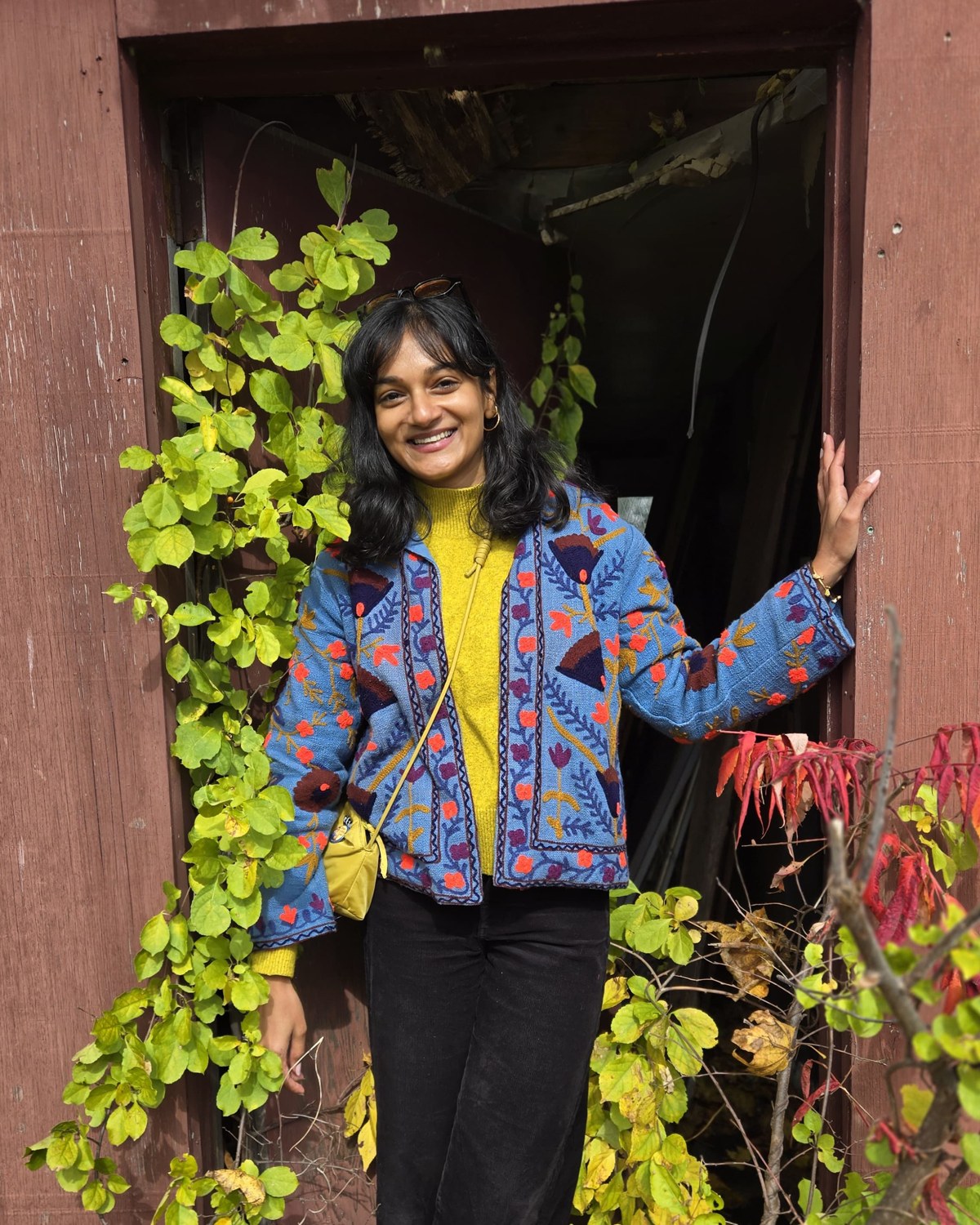
I'm Swetha Baskaran, an artist who grew up in Chennai, India, and has lived in New York for the past decade. I began practising Kalamkari in 2016.
Kalamkari is a hand-drawn, naturally dyed textile tradition from South India. Its name joins the Persian qalam (pen) and kari (craftsmanship). For centuries, travelling storytellers carried painted Kalamkari cloths from village to village, unrolling scenes from the Ramayana and Mahabharata panel by panel as they narrated the epics. The cloths later travelled much further, prized as trade goods from Persia to Europe. My current work turns that storytelling tradition toward my own life as an immigrant in New York.
Training
Trained in Kalamkari with Brooklyn-based artist Nikita Shah through private lessons and a six-week intensive workshop, covering both technique and theory: how the style differs from region to region, how it evolved under different patrons, and how natural dyes and mordants work. Nikita, one of very few Kalamkari practitioners in the United States, trained through mentorship with Mamata Reddy, founder of KalamCreations and a revivalist of the tradition in India.
Further Kalamkari workshops at Kalakshetra Foundation in Chennai, the arts institution founded in 1936 by Rukmini Devi Arundale. Best known for classical dance and music, Kalakshetra also runs a Kalamkari unit, re-established in 1978 to revive hand painting and printing with vegetable dyes.
Also trained in three other Indian painting traditions: Pichwai and Madhubani (see Beyond Kalamkari), and Warli, the tribal art of Maharashtra, which depicts daily life in simple white figures on earthen walls.
Outside the Studio
I've been coding since high school. After a Master's degree in Computer Science and 12 years in technology, I now lead a team of data engineers at Etsy, a company I chose partly because it supports artists and small business owners.
Contact
For commissions, prints, or just to talk Kalamkari.